Frame Damage on a Used Car Hides in These Six Spots
 By Anthony LimpertASE Business Built With Master Automotive Technicians
Six places frame damage shows on a used car, what a history report misses, why a bad repair is the real risk, and California's certified car rule.
- On most cars there is no separate frame. The body is the frame, so a fender bender can reach it.
- Check six spots. Panel gaps, paint, bolts, the trunk floor, the rails underneath, and how the car tracks.
- A clean history report is not proof. Many crashes never reach one.
- A frame repair done to the maker's steps can be fine. One done without them is the danger.
- In California, a dealer can't sell a car as certified if it knows it has frame damage.
In California, the word certified carries a rule. A dealer can't advertise or sell a used car as certified if it knows, or should have known, the car has frame damage (California Vehicle Code 11713.18). The same section bars the label on an as is sale. It also makes the dealer hand you a completed inspection report first.
That rule covers one label on one kind of sale. A private seller owes you no such thing. Neither does a dealer selling a plain used car with no certified sticker. So we wrote down where to look, in the order we look.
Frame Damage Means Two Different Things
Pickups and a few big SUVs and vans still bolt the body onto a ladder frame. That is two steel rails joined by crossmembers. Most cars, vans and small SUVs are unibody. The frame and the body skeleton are built as one piece (Kelley Blue Book).
That changes what frame damage means. On a truck, it means a bent or cracked rail. It often takes a side hit, like a pole or a T-bone, to bend one. On a unibody car, damage to the pillars or a strut tower counts too. Kelley Blue Book says any damage to the car's core skeleton is basically frame damage.
Unibody cars have crumple zones built in. They fold on purpose to soak up a crash. So a front or rear hit is nearly as likely to reach the structure as a side hit. A car can look like it had a small bumper job and still have a pulled front rail behind it.
A Bad Repair Is the Real Risk
Frame damage can be fixed. The question is how it was fixed.
I-CAR trains collision techs. Its first answer on any structural repair is to follow the carmaker's procedures. It calls those steps service specifications, not suggestions (I-CAR). Some parts can't be pulled straight at all. I-CAR's best practice says certain ultra high strength steel parts get replaced, never straightened.
Carmakers set hard lines too. Stellantis, which owns Jeep, Ram, Dodge and Chrysler, says a structural steel part that was heated to straighten it must be replaced. It allows cutting in a new section only where its own repair manual shows how (I-CAR, FCA/Stellantis sectioning and heat).
That is why the repair paperwork matters more than the word repaired. A cheap shop can heat a rail, pull it close, and paint over it. The car drives fine. It just won't fold the way it was built to in the next crash.
Six Spots to Check Before You Pay
Do this in daylight, on flat ground, before the test drive. Bring a flashlight.
- Panel gaps. Crouch at each corner and sight down the sides. The gaps around the hood, doors and trunk should match side to side. A door that sticks or a gap that is wide at the top and tight at the bottom is a flag.
- Paint. Look along each panel at an angle. Color that is a shade off, orange peel texture, or overspray on rubber seals means paint work. A paint gauge makes it a number. Compare the panels to each other.
- Bolts. Open the hood. Look at the bolts on the fenders, hood hinges and the radiator support. Wrench marks or chipped paint on bolt heads mean those parts came off.
- Trunk floor and door jambs. Lift the trunk carpet and the spare tire. Ripples, fresh seam sealer or weld marks in the floor point to a rear hit. Check the pinch welds under the door sills for crushed or bent edges.
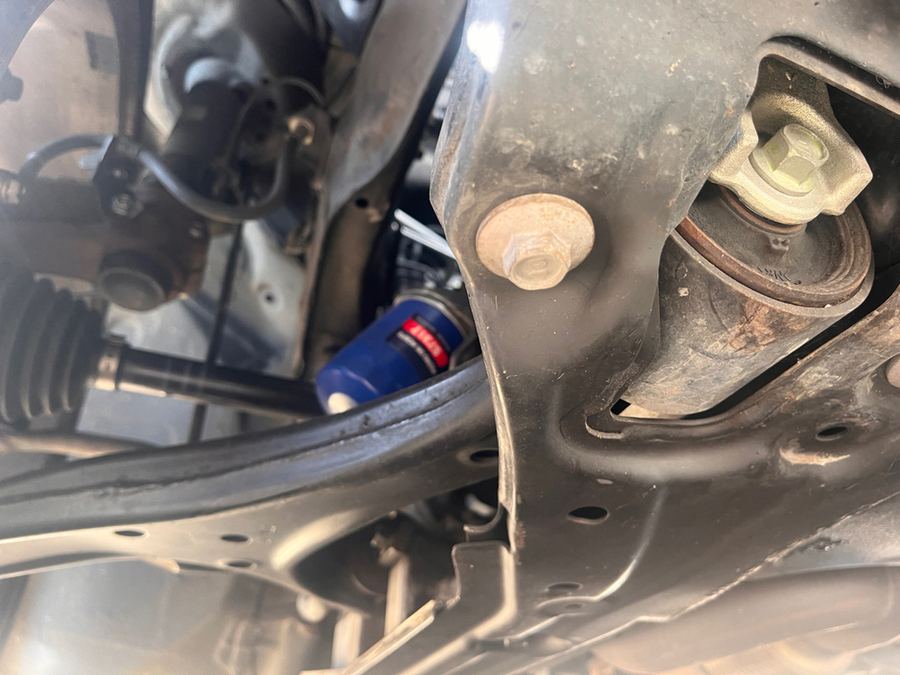
- Underneath. Look at the frame rails or the front subframe from below. Kinks, wrinkles, fresh undercoating in one spot, or new welds are the signs. Clamp marks on the pinch welds can mean the car sat on a frame machine.
- How it tracks. On the drive, the car should go straight with the wheel centered. Have a friend follow you. The rear wheels should follow the front ones. A car that runs a little sideways, like a crab, is a classic bent frame sign.
Kelley Blue Book lists the same road signs. A pull that stays after an alignment, odd tire wear, and new rattles all point back to the structure.
About paint gauges. One patent for reading car damage used 4.0 to 6.5 mils as the normal factory paint range. A panel well over that reads as refinished (US Patent 6,055,860). Makers differ, so the number that matters is the gap between panels on the same car. A repainted door is not frame damage. A repainted quarter panel next to a wavy trunk floor might be.
What a History Report Shows
The FTC says a vehicle history report may list accidents and flood damage. It also says the report is not a substitute for an independent inspection (Federal Trade Commission). A crash paid in cash, with no police report and no claim, often never shows up.
The flag can be wrong the other way too. Carfax's Canadian help desk says a frame damage report can come from a past police car, a plow or a hitch bolted to the frame, heavy rust, or minor marks that don't weaken the car (Carfax Canada). So a flag is a reason to look, not a verdict.
The federal title database, NMVTIS, is narrower still. It reports five things, like brands such as salvage or flood, the last odometer readings and insurance total loss calls (NMVTIS). A frame repaired under a regular claim, with no total loss, has no reason to be there. The guide to reading a vehicle history report shows what each line means, and the post on salvage titled cars covers branded titles.
What Buyers Say About the Lots
The PPI Auto dealer directory grades used car lots from their reviews. It tracks 35,341 used lots, and 16,252 have enough reviews to grade, as of September 24, 2026. That is PPI Auto's own data.
Who Buyers Grade Higher
Share of graded used lots. PPI Auto dealer directory, September 24, 2026.
Buyers bring up the Carfax in reviews at 71 used lots. Of the 69 with a grade, 36 percent earn an A, against 21 percent of all graded used lots. Only 12 percent get an F, against 19 percent overall. Lots that hand over the report get credit for it.
Lots where reviews talk about salvage or rebuilt titles are a different story than you might guess. There are 304 of them. Of the 288 graded, 20 percent are an F, about the same as everyone. A lot that sells a rebuilt car and says so is not the trap. The trap is the repaired car sold as clean. The guide to checking out a car dealer shows what else to read for.
Walk, Price It, or Buy It
Use what you found to pick one of three.
- Buy it. Even gaps, factory paint, untouched bolts, a clean trunk floor and straight tracking. Or a past repair with the shop's invoice showing it was done to the maker's procedure.
- Price it. One repainted panel or a replaced bumper with no structural signs. Cosmetic work is common. Kelley Blue Book notes frame damage lowers resale value, and you will face that when you sell.
- Walk. Kinked rails, fresh welds with no paperwork, a crabbing car, or a seller who won't let a mechanic look. The FTC says to think about another dealer if one won't allow an outside inspection.
On a car you love with a known repair, ask a body shop to put it on a measuring system. It checks set points against the maker's specs. That is the only way to know the structure is back where it belongs.
Verified Against
- California Vehicle Code Section 11713.18, certified used vehicles, via FindLaw
- Kelley Blue Book, Car Frame Damage, Russ Heaps, updated April 8, 2025
- I-CAR, Always Follow Vehicle Maker Procedures, validated 2025
- I-CAR, Structural Sectioning Procedures, FCA/Stellantis, validated 2025
- Federal Trade Commission, Buying a Used Car From a Dealer, April 2024
- Carfax Canada, Why Was Structural Damage Reported
- National Motor Vehicle Title Information System, Consumers
- US Patent 6,055,860, Method for Measuring Vehicle Damage, 2000
- NAPA Know How, What Is Car Frame Damage, June 19, 2020
- PPI Auto dealer directory, 35,341 used car lots, September 24, 2026 (our own data)
Every PPI Auto inspection checks the frame for rust, past crash repair, welds and paint depth. See what a used car inspection covers, or check what an inspection costs before you drive out to see one.
Real Questions From Real Calls
How do you tell if a car has frame damage?
What is considered structural damage to a car?
Can I still drive my car if the frame is bent?
How much does it usually cost to fix a bent frame?
Does Carfax always show frame damage?
Should I buy a car with frame damage?
Buying a vehicle? Let us check it first.
Call 951-267-8500