How Much Should 4 Brake Pads Cost?
 By Anthony LimpertASE Master Automobile Technician
About $150 to $350 for one axle of pads, and $300 to $700 for all four wheels. Here is how a used car buyer reads the pad and rotor numbers and turns them into money off the price.
We inspect a lot of used cars, and brakes come up on almost every report. The seller says the brakes are fine. The car stops, so you believe it. Then three months later a shop tells you the car needs pads and rotors on both ends, and the bill is yours.
Brakes are the easiest repair to price before you buy. The pads and rotors can be measured. A number you can measure is a number you can negotiate with.
The Short Answer
A shop charges about $150 to $350 per axle to replace brake pads, or $300 to $700 for the front and rear together. Add new rotors and one axle runs about $250 to $500. Those ranges come from AAA's brake pad cost guide, which we read on October 10, 2026. RepairPal's estimator, updated September 3, 2026, puts the average brake pad job at $335 to $394 (RepairPal).
- Four brake pads is one axle. Each wheel has two pads, one on each side of the rotor.
- Pads alone run about $150 to $350 per axle at a shop. Pads and rotors run about $250 to $500 per axle.
- A full brake job on both axles with rotors can pass $1,000 on a bigger or pricier car.
- An inspection measures what is left on the pads and checks the rotors, so you know the bill before you buy.
- Use that number to ask for money off, or to have the seller do the work first.
Why 4 Brake Pads Means One Axle
This trips people up. A disc brake squeezes the rotor from both sides, so every wheel has an inner pad and an outer pad. Two wheels on an axle means four pads in the box. When someone asks what 4 brake pads cost, they are almost always asking about one axle, the front or the rear.
Shops price brakes by the axle for a reason. Both sides of the car need to grip the same, so pads get changed in pairs across the axle. If a quote says all four wheels, that is two sets, or eight pads in all.
What a Brake Job Really Costs
Here is how the AAA and RepairPal numbers stack up. These are shop prices with parts and labor. Your car, your town and the parts the shop uses will move them.
| The Job | Typical Shop Price | Source |
|---|---|---|
| Pads, one axle (4 pads) | $150 to $350 | AAA |
| Pads, both axles (8 pads) | $300 to $700 | AAA |
| Pads and rotors, one axle | $250 to $500 | AAA |
| Brake pad replacement, national average | $335 to $394 | RepairPal, September 3, 2026 |
| Brake rotor replacement, national average | $574 to $698 | RepairPal, September 3, 2026 |
AAA says a standard pad change takes about an hour per axle, while rotor work or bleeding the brakes can take two to three hours. That is why rotors move the bill so much. RepairPal shows the same thing. Its rotor replacement estimate of $574 to $698 is far above its pad estimate (RepairPal rotor estimator).
The car matters too. RepairPal lists a Honda CR-V pad job at $264 to $321 and a Nissan Altima at $382 to $444. A heavy truck or a European SUV with big rotors will cost more than a compact. So when you price a used car, price its brakes, not brakes in general.
How an Inspection Measures Brake Life
Most buyers press the pedal on the test drive and call it good. A car can stop fine with pads that are nearly gone. Wear is something you measure, not something you feel.
New pads start out about 3/8 inch to 1/2 inch thick, depending on the car. Some shops want them replaced at about 1/4 inch, and others say 1/8 inch, Cars.com explains. That gap is why one shop says your pads are done and another says you have a year left. Both can be honest.
There is a hard floor, too. Virginia's safety inspection rule fails a car when a disc pad is worn to less than 2/32 of an inch at any point. For rotors, it says to use the spec stamped on the rotor (19VAC30-70-80). Many rotors carry a minimum thickness stamp. Once a rotor wears or gets cut below it, the rotor is done. Turning it smooth again is not an option.
Here is what the inspector looks at. Our checklist has a full Brake System section with Front Linings, Rear Linings, Calipers, Lines and Fittings, Fluid Level, Fluid Leaks and the ABS System. You can read every line on our inspection checklist. The report includes tire and brake measurements, with photos of anything that matters.
Read the Numbers Like a Mechanic
This table turns what the inspector finds into what you should budget. The dollar ranges are the AAA shop prices above.
| What the Inspection Finds | What It Means | What to Budget |
|---|---|---|
| Pads 1/4 inch or thicker | Plenty of pad left | Nothing now |
| Pads between 1/4 and 1/8 inch | Due soon | $150 to $350 per axle, soon |
| Pads at 1/8 inch or less | Due now | $150 to $350 per axle, now |
| Pads under 2/32 inch | Would fail a Virginia safety inspection | Due now, and check the rotor |
| Rotor at or near its stamped minimum | Rotor goes with the pads | $250 to $500 per axle |
| Deep grooves or a big lip on the rotor edge | Rotor wear, often from pads run too long | Plan on pads and rotors |
| Grinding noise on the road test | Pad may be gone, metal on the rotor | Pads and rotors, now |
| One pad much thinner than the other | A caliper or slide may be sticking | Get a caliper quote too |
The grinding row is from Wagner, the brake parts maker. It says a grinding sound may mean the pads have worn through and are grinding into the rotors (Wagner Brake). At that point a pads only job is off the table.
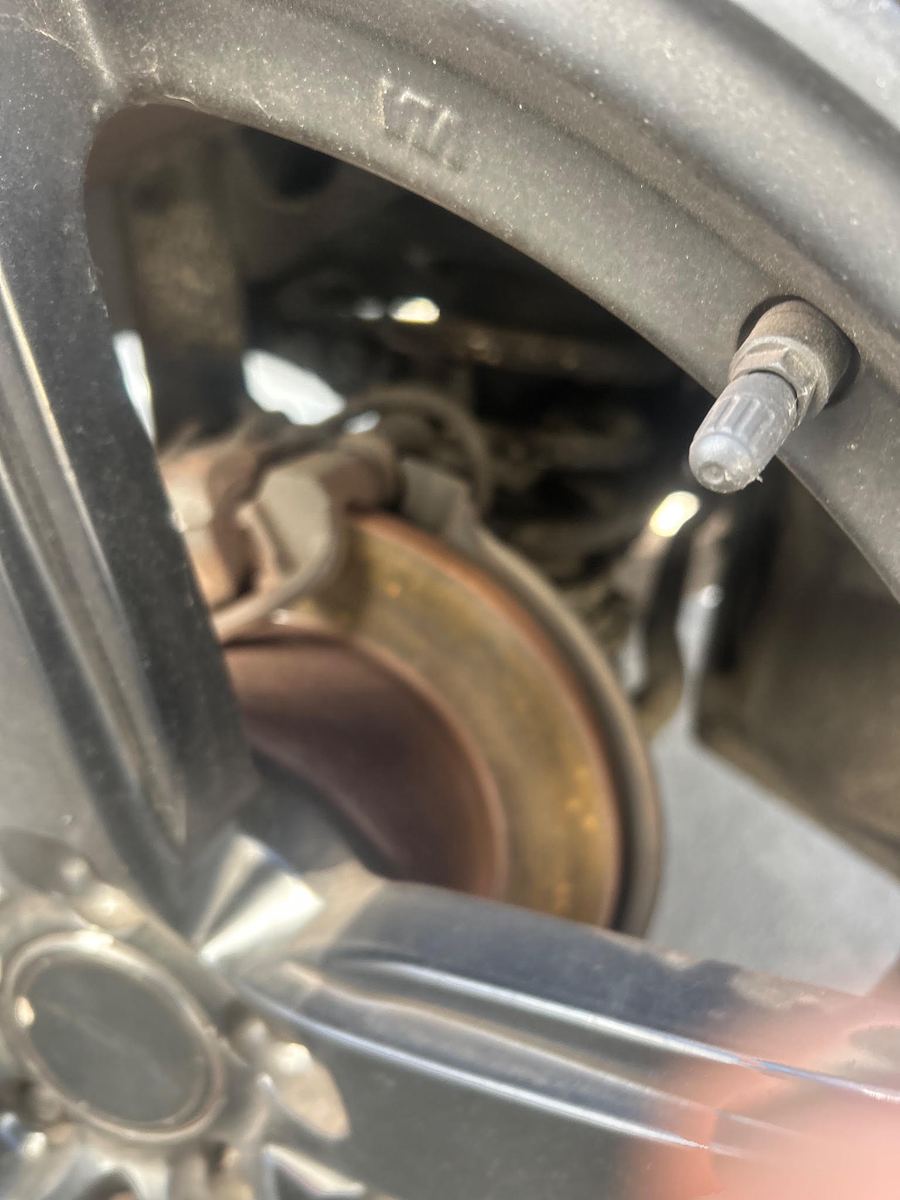
A rotor with rust and a lip on its outer edge, from a G-Class we inspected on a dealer lot.
That lip is a clue you can see through the wheel. The pad wears the face of the rotor down, and the edge it never touches stays tall. A big lip means a lot of the rotor is gone. You can see the rest of that car on our G-Class inspection page.
How Long the Brakes Have Left
AAA says brake pads last about 30,000 to 80,000 miles, depending on how and where the car is driven and what the pads are made of. That range is too wide to guess with. The measurement is what narrows it.
Here is a worked example. Say new pads on a car are 3/8 inch, about 9.5 mm. The shop will replace them at about 3 mm. That leaves about 6.5 mm of pad to use. If the inspection finds 6 mm, the car has used a bit more than half of its usable pad. Ask how many miles the last brake job was done at, and you can roughly guess how long the rest will last.
Stop and go city driving, hills and heavy loads burn pads faster. A highway commuter can go a long time. If the seller has receipts from the last brake job, the date and the miles on that receipt are worth more than any guess.
How to Use the Brake Number to Negotiate
This is where the inspection pays for itself. A brake finding is one of the cleanest things to bargain with, because it comes with a measurement and a price range anyone can look up.
Here is a worked example. You find a sedan you like. The inspection shows front pads at 1/8 inch and front rotors with a heavy lip. The rear pads are near 1/4 inch. The front axle needs pads and rotors now, which AAA puts at $250 to $500. The rear pads have some life left, but they are next.
- Get a written quote for the front pads and rotors from a shop near you. That turns a range into one number.
- Show the seller the report and the quote. Ask for that amount off the price.
- Or ask the seller to do the brake job before the sale, with a receipt that lists the parts.
- Mention the rear pads, but do not lean on them. They are wear, not a defect, and a fair seller will see that.
- If the report shows grinding, a sticking caliper or a soft pedal, treat it as a safety issue. Fix it before you drive it home.
Dealers are not exempt. The FTC says it is always a good idea to have an independent mechanic inspect a used car, even one the dealer has certified. It also says a car sold As Is means the dealer will not pay for problems after the sale (FTC, April 2024). On an As Is car, a worn brake job you did not catch is your bill from the moment you sign.
What Most Price Guides Get Wrong
Most pages on this question are written for the person who already owns the car. They give a range, tell you to shop around, and stop. That is fine for an owner. A buyer has a better move.
Before you buy, the brake bill is still the seller's problem. After you buy, it is yours. The same $400 front brake job can be money off the price or money out of your pocket. The only thing that decides which is whether someone measured the pads and rotors before you paid.
Brakes also hide other clues. Fresh pads on worn rotors can mean a cheap quick fix before the sale. Rotors that look new on a car with no receipts are worth a question. Our post on how sellers hide a check engine light covers the same kind of pre sale cleanup under the hood.
Buying a Used Car Soon?
PPI Auto inspects used cars for buyers in all 50 states, and every report carries brake and tire measurements. See what a used car inspection covers, or check what an inspection costs.
Sources
- AAA Automotive, How Much Does It Cost to Replace Brake Pads, read October 10, 2026
- RepairPal, Brake Pad Replacement Cost Estimate, updated September 3, 2026
- RepairPal, Brake Rotor Replacement Cost Estimate, updated September 3, 2026
- Cars.com, How to Check Brake Pads, September 18, 2018
- Virginia Administrative Code, 19VAC30-70-80 Service Brakes
- Wagner Brake, How to Check Brake Pads
- FTC, Buying a Used Car From a Dealer, April 2024
Common questions
How much should 4 brake pads cost?
How much should 4 brake pads cost to replace?
Should I replace all four brake pads at once?
How long do brake pads last?
Can I drive with bad brake pads?
Does a pre purchase inspection check the brakes?
Buying a vehicle? Let us check it first.
Call 951-267-8500